The model behind this service
The Community Pyramid
It shows what turns a group of people into a community, in the order it usually happens. Created by Miikka Leinonen and Jussi Tapio at Ghost Community.
Select a block to read about it.
Benefit
Create interest by serving the members. People come because they get something real out of it: learning, status, help with their own work, or a sense of being valuable. Benefit is the entry point, and the group is still an audience until it is in place.
Warning signs
- People attend mainly so they can say they are part of the group.
- Other work outranks the community, and people stop showing up.
- Nobody can say what members get out of it or what keeps them coming back.
- Answers about the value are polite rather than real.
Trust
Help members create personal bonds. Members see each other as whole human beings, not work roles, and can admit not knowing and share what didn't work.
Warning signs
- People talk only about their job titles and expertise.
- Nobody shares failures, fears or unfinished work.
- The lead or the most confident members do all the talking.
- Rules about how members treat each other were written by the lead, or never written.
Sharing
Allow people to give what they have and learn from each other. Help comes from members, not from the lead or outside experts. Sharing creates benefit, and benefit grows trust, which leads to more sharing.
Warning signs
- The shared channel stays quiet unless the lead posts.
- AI skills are treated as the only thing worth sharing.
- Gatherings are one-way, with a speaker and an audience.
- Members only take, and the lead answers every question.
Purpose
Create a shared story of the desirable future. The community writes its own purpose, linked to the strategy, and keeps it visible. It only works once people trust each other.
Warning signs
- The purpose is copied from the strategy, or set by a sponsor as a task list.
- Members don't recognise their own ideas in the purpose statement.
- The purpose is never revisited.
- The community is treated like a department that can be given explicit tasks.
Ownership
Share responsibilities for actions and outcomes. Members take roles that aren't their job titles, make decisions, and run sessions outside the community. It fails if forced too early, before Benefit, Trust and Purpose.
Warning signs
- The lead holds on too tightly and runs the community like ordinary business.
- Members are reluctant to take on new tasks.
- There is no time code, licence or line-manager agreement for community work.
- Nobody has a role, or everyone picked the same role as their job.
Identity
The community becomes part of members' personal story. They are committed and courageous, and they talk about "we".
Warning signs
- Activity and energy drop: people miss meetings, arrive late, leave early or vanish.
- Long-standing members hold on for the badge but contribute little.
- Energy on the surface hides little real contribution.
- Nobody looks back, celebrates or marks milestones.
Why a community needs its own model
Building an internal community is different from most other work in a company. A project has people assigned to it and a clear deadline. A community usually has a lead who is paid for the role, but its members are volunteers, and its deadlines are often blurry. Members are there because they care about the topic: they want to learn, share and take the company forward.
So a community runs more on passion and curiosity than most projects do, and it can't be led in quite the same way. You can't assign enthusiasm or put trust on a schedule. A community needs different structures, and the person leading it needs to understand how communities work.
What the model gives you
- The basic needs. You see what a community needs before it can work.
- A way to troubleshoot. When something goes wrong, you can pinpoint where the challenge sits, without guessing.
- A shared map. You, your sponsor and your members can talk about community building in the same words, and ask together: are we doing this the right way?
The typical mistake is to rush
People are eager to get a community going, so they skip ahead. A common case: the lead offers members ownership of the community before the foundation is in place. It leads nowhere, because people don't take ownership of something they are not yet committed to. The model shows what has to hold first.
Where the model comes from
The AI Community
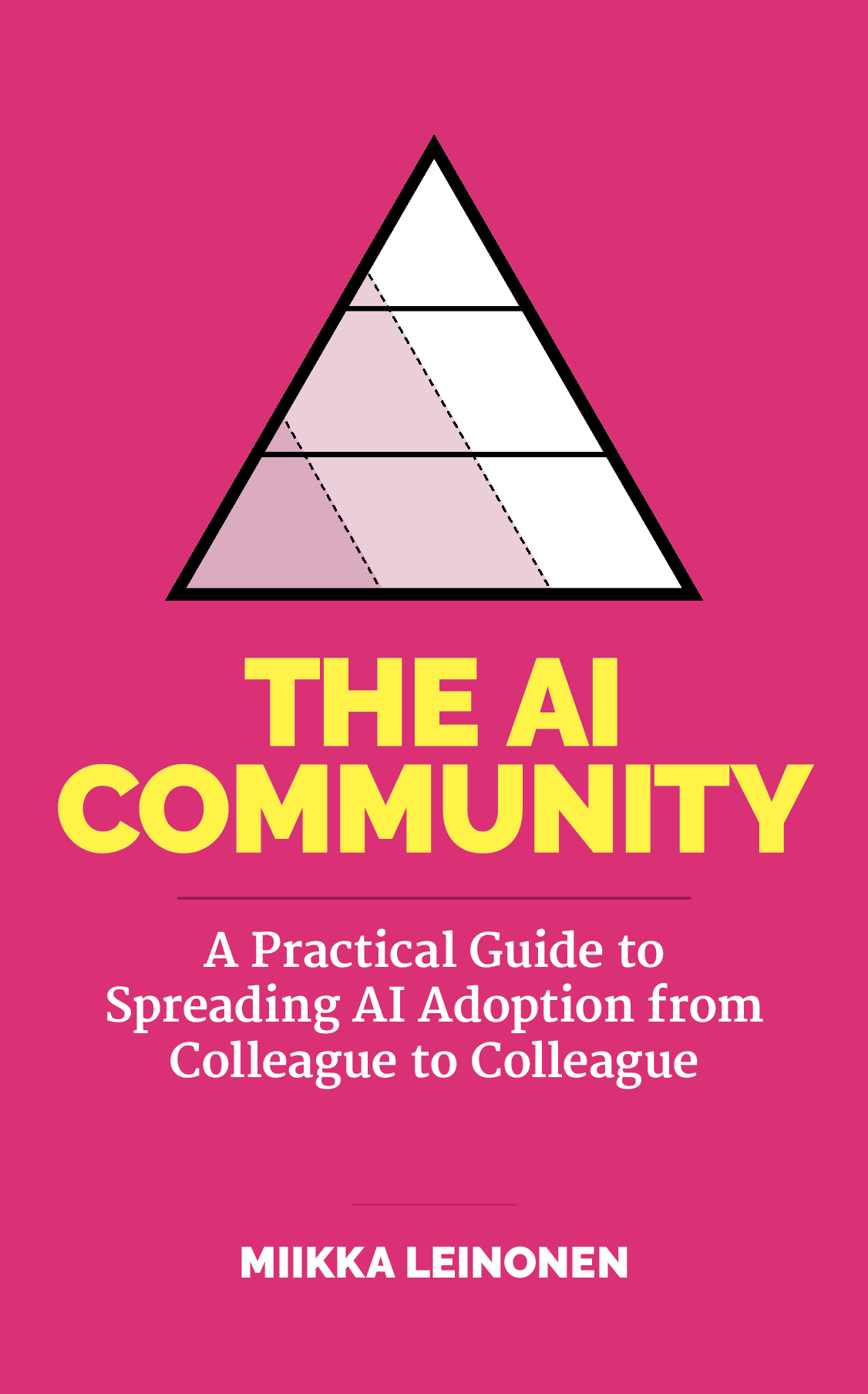
A Practical Guide to Spreading AI Adoption from Colleague to Colleague, by Miikka Leinonen.
The book explains the Community Pyramid in full, block by block, with practices you can try on Monday. Read it if you want the whole method behind this service.
Where does your community stand?
The community snapshot places your community on the pyramid in about ten minutes.
Take the free community snapshot